
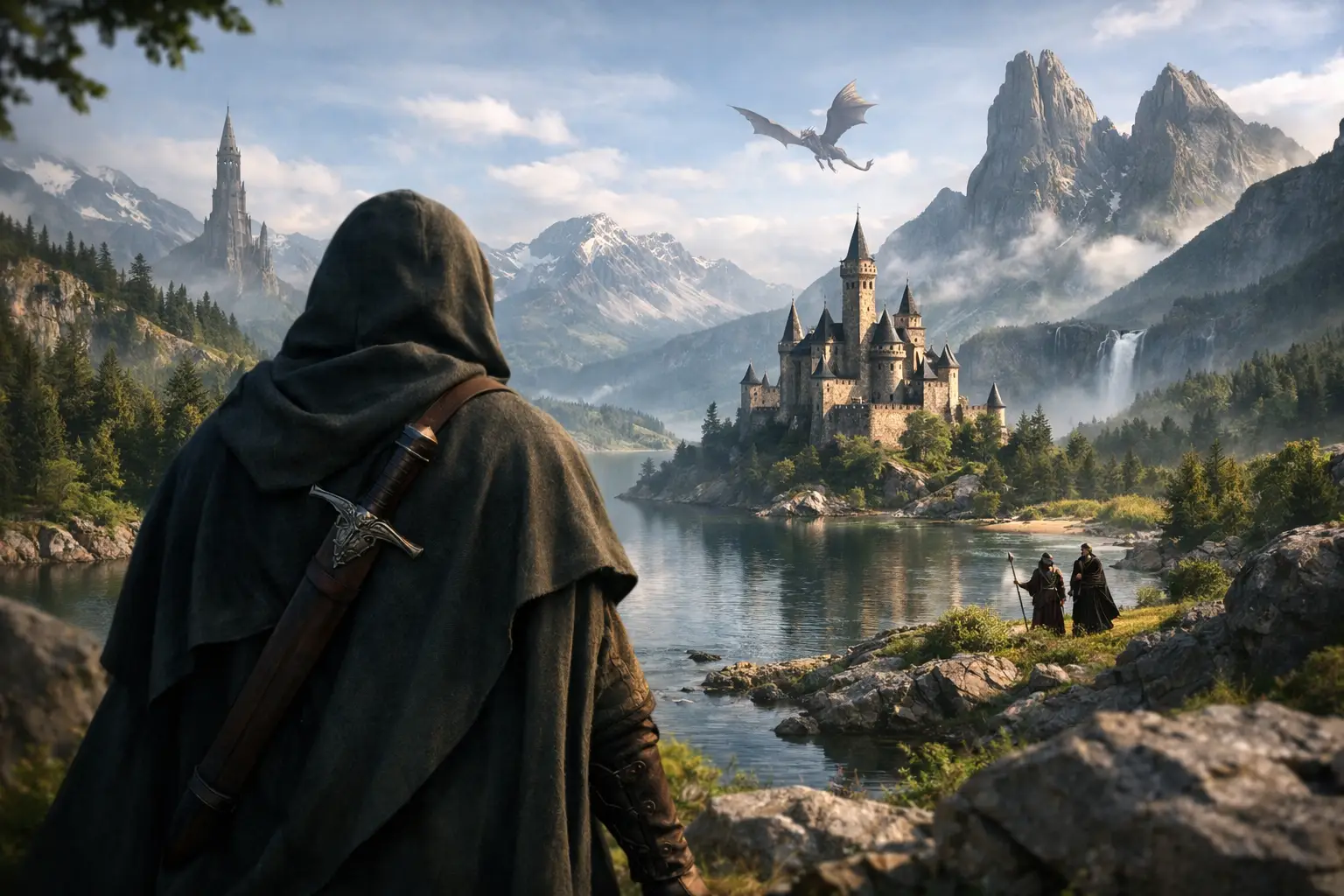
Some stories give you a strange city, a magical artifact, and a brush with the uncanny. High fantasy goes further. If you’ve ever asked what is high fantasy fiction, the short answer is this: it’s fantasy set in a secondary world, shaped by large-scale conflict, mythic stakes, and a reality that runs on rules other than our own.
That definition sounds clean on paper. In practice, high fantasy is less about a checklist and more about narrative scale. These are stories built to feel older, larger, and more elemental than ordinary life. Kingdoms fall. Ancient powers wake. Prophecy, war, lineage, faith, and destiny tend to matter. Even when the cast is intimate, the world around them rarely is.
What Is High Fantasy Fiction at Its Core?
At the center of high fantasy is separation from the real world. The story usually takes place in an invented setting with its own geography, cultures, history, belief systems, and often its own cosmology. Middle-earth is the obvious touchstone, but the form has expanded far beyond that model.
A high fantasy world does not just host the plot. It shapes the plot. Politics, magic, religion, bloodlines, and old conflicts are not background decoration. They create pressure on every choice the characters make. A farm boy, a disgraced knight, a scholar, or a thief may begin with local concerns, but the story tends to pull them toward something far bigger.
This is one reason high fantasy attracts readers who want immersion rather than a quick premise. The pleasure is not only in what happens next. It is in sensing the depth under the page – the old empires, the dead languages, the buried wars, the cost of power, the map beyond the map.
The Traits Readers Usually Recognize
High fantasy often includes magic, invented races or creatures, royal houses, quests, and continent-level stakes. But none of those elements alone defines the genre. You can have dragons without high fantasy. You can have a king without high fantasy. You can even have an invented world that feels too narrow or too contemporary in its storytelling to fully land in the mode.
What usually marks high fantasy is the combination of secondary-world setting and mythic scope. The conflict tends to matter beyond one household or one city block. The moral pressure is heavier. The atmosphere often carries a sense of age, inheritance, and consequence.
That said, the genre is flexible. Some high fantasy is bright and heroic. Some is brutal, political, and skeptical of destiny. Some leans lyrical and spiritual. Some is military, grim, or strange. The old stereotype that high fantasy must sound archaic or revolve around chosen ones is too narrow for the field as it exists now.
High Fantasy vs. Low Fantasy
This is where people get tripped up. In casual conversation, “high” and “low” often sound like value judgments, as if one is more serious or more ambitious. That is not really the point.
Traditionally, high fantasy refers to stories set in a secondary world, while low fantasy places magical or fantastical elements into the primary world – our world, or a version close to it. By that standard, a portal fantasy that begins on Earth and crosses into another realm can blur the line. Urban fantasy, supernatural horror, and magical realism usually sit elsewhere because they keep one foot in familiar reality.
But genre labels shift. Some readers also use “high fantasy” to mean epic in scope, and “low fantasy” to mean smaller, grittier, or less magic-forward. That usage is common enough that context matters. If someone says a book is “high fantasy,” they may mean the setting is fully invented, or they may mean the story feels grand, layered, and mythic.
Both uses are understandable. The safer read is to look at the world first, then the scale.
Why Epic Stakes Matter So Much
High fantasy tends to magnify consequence. A betrayal is not just personal. It may fracture a kingdom. A magical failure does not just wound one character. It may alter the balance between nations, gods, or entire species. That expansion of consequence is part of the genre’s charge.
This does not mean every high fantasy book needs constant battlefield spectacle. Some of the strongest examples build slowly. They invest in court politics, pilgrimages, religious tension, private grief, or fractured alliances. The scale is still there, but it unfolds through pressure rather than noise.
That trade-off matters. A bigger canvas can produce awe, but it can also flatten character if the book cares more about lore than people. The best high fantasy keeps both in play. The world feels ancient and vast, yet each turning point still lands because someone specific has to pay for it.
What Makes the Worldbuilding Feel “High”
Worldbuilding in high fantasy is not just detail density. Plenty of books have detailed settings. What makes high fantasy distinct is that the setting feels foundational. The world has structure, memory, and internal gravity.
Readers usually feel this in a few ways. There is a sense of recorded time – dynasties, ruins, fallen orders, recurring myths. There is often a coherent relationship between magic and society. Religion may influence law, warfare, or class. Geography matters because mountains isolate regions, seas shape trade, and old roads still carry the weight of past empires.
None of this has to be explained all at once. In fact, high fantasy often works better when it trusts the reader. A world can feel deep without turning every chapter into a briefing document.
That balance is hard. Too little grounding and the story feels vague. Too much exposition and it stalls. Readers who love the genre are usually looking for control, not clutter – enough design to believe in the world, enough restraint to keep the narrative alive.
Is High Fantasy Always Medieval?
No, though the genre has long been associated with medieval or pseudo-medieval aesthetics. Castles, swords, mounted warfare, hereditary rule, and guild-like social structures are common because they support hierarchy, travel difficulty, and visible power.
Still, high fantasy does not belong to one historical skin. You can build it around bronze-age collapse, desert empires, frontier republics, decaying city-states, or stranger hybrids. The deeper requirement is not chain mail. It is a world with its own civilizational logic and enough scale to sustain mythic conflict.
This matters because modern readers often want more than recycled surface texture. Familiar imagery can be effective, but only if the setting has a real point of view. Otherwise the world starts to feel borrowed instead of lived in.
Why Readers Keep Coming Back to It
High fantasy offers a particular kind of reading experience: total relocation. Not escape in the shallow sense, but reorientation. It asks you to inhabit a world where power has older names, where history is physically present, and where private choices can carry civilizational weight.
For many readers, that is the draw. The genre makes room for scale without abandoning intimacy. It lets a story hold war and grief, prophecy and logistics, gods and mud. It can be idealistic, tragic, or morally torn. It can stage the oldest human questions inside invented systems and still make them feel immediate.
There is also a craft reason it endures. High fantasy is unusually good at creating reader loyalty. When a world feels fully made, readers do not just finish the book. They stay in orbit around the author, waiting for the next map edge, the next ruined throne, the next fracture in the order of things. That long-tail connection is part of why the form remains so alive.
So, What Is High Fantasy Fiction Really?
It is fantasy that builds its own world and treats that world as consequential. It usually works at a larger scale than everyday life, whether through war, prophecy, political upheaval, spiritual conflict, or ancient magic. It invites immersion, but it also demands design. The setting cannot be a painted wall. It has to generate pressure, belief, and consequence.
If that sounds broad, it is. High fantasy contains classic quest narratives, court intrigue, grim war sagas, literary epics, and newer cross-genre work that bends the form without breaking it. The core remains recognizable: a world apart, a story with weight, and a sense that history is always moving beneath the visible plot.
For readers who want fantasy to feel vast, deliberate, and fully inhabited, that is usually the signal. And for writers, it is the challenge – not just to invent a world, but to make it feel old enough to cast a shadow.