
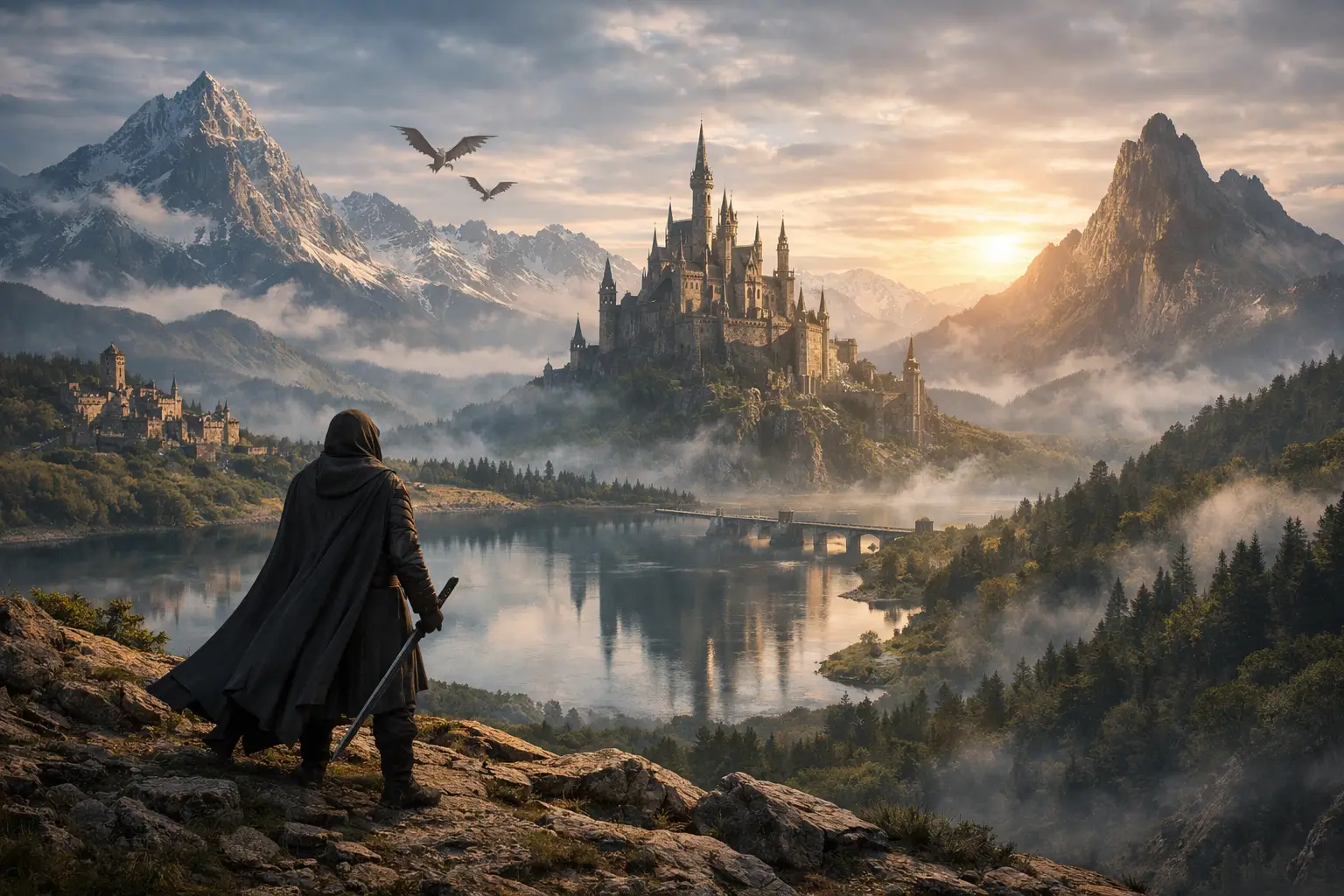
A farm boy with a strange destiny is part of it. A fallen kingdom helps. So do ancient evils, impossible maps, dead languages, prophecies, sword lines, ruined empires, and wars that decide more than one life at a time. But if you are asking what is epic fantasy, the real answer is less about surface furniture and more about scale, weight, and consequence.
Epic fantasy is fantasy written on a grand canvas. The world feels large, old, and layered. The conflict reaches beyond private survival and touches a people, a realm, or the fate of an age. Characters may begin in small places, but the story keeps widening until it carries political, spiritual, military, or mythic force. That expansion is the heart of the genre.
What Is Epic Fantasy at Its Core?
At its core, epic fantasy is a mode of storytelling built around high stakes in an invented or heavily mythologized world. The setting matters as much as the plot. History matters. Lineage matters. Power matters. Even the landscape often feels charged with memory, as if the land itself remembers wars, gods, betrayals, and bargains made long before the first chapter.
The word epic can mislead people. It does not just mean long. Plenty of long fantasy novels are not epic fantasy, and some epic fantasy stories are relatively compact. Epic, in this case, points to scope. The story reaches outward. It connects personal choices to larger structures like kingdoms, armies, cosmic forces, ancient orders, or civilizational collapse.
That is why the genre often feels serious even when it includes wonder. It tends to ask what power costs, what duty demands, and what survives when an old world starts breaking.
The Traits That Usually Define Epic Fantasy
Most epic fantasy shares a handful of recognizable traits, though not every book uses all of them.
First, the setting is usually secondary world fantasy. That means the story takes place in a fictional world rather than the real one. It may have its own geography, religions, politics, calendars, languages, and systems of magic. The point is not decorative detail for its own sake. The point is immersion. A true epic fantasy setting feels lived in before the protagonists arrive.
Second, the stakes extend beyond the individual. A single character may be trying to save a sibling, reclaim a title, survive exile, or understand a strange power. But those private motives usually tie into something larger. The fall of a city. The return of a dark force. A war between empires. A shift in the order of the world.
Third, epic fantasy often works with ensemble storytelling. Even when there is a clear lead, the narrative tends to widen. You move between courts, battlefields, borderlands, hidden strongholds, and sacred ruins. Different characters carry different parts of the conflict, and the book gains force by showing how those pieces collide.
Fourth, history has weight. In epic fantasy, the past is rarely dead background. Old oaths still matter. Forgotten bloodlines still matter. Lost artifacts still matter. What happened centuries ago may still be shaping the present through law, myth, prejudice, prophecy, or curse.
Fifth, the tone usually leans mythic, even when the prose is plain. That does not mean every sentence sounds ancient. It means the story gives events a sense of consequence. Characters are not just stumbling through random danger. They are moving through forces that feel older and larger than themselves.
What Makes Epic Fantasy Different From Regular Fantasy?
This is where genre labels get slippery, because fantasy is a huge field. Not every fantasy novel wants to be large-scale, and that is not a flaw. Some of the best fantasy is intimate, strange, comic, or narrowly focused.
Epic fantasy differs in the size of its frame. A smaller fantasy novel might center one city, one relationship, one crime, one haunted manor, or one magical problem. Epic fantasy tends to build toward systemic impact. If the story resolves, the world changes with it.
It also tends to invest more heavily in social and political architecture. Who rules. Who serves. Who remembers. Who controls magic. Who writes history. These questions sit close to the action, not far behind it.
That said, scale alone is not enough. A book can include a war and still not feel epic if the world itself seems thin or if the conflict has no mythic or civilizational depth. Epic fantasy needs breadth, but it also needs density.
High Fantasy, Sword and Sorcery, and Epic Fantasy
People often use high fantasy and epic fantasy as if they mean the same thing. Sometimes they overlap. Often they do. But there is a useful distinction.
High fantasy usually refers to fantasy set in a fully invented world with a strong separation from ordinary reality. Epic fantasy often fits that description, but it adds the question of scale. A high fantasy story can be intimate. An epic fantasy story is usually wider in consequence.
Sword and sorcery is different again. It tends to be faster, rougher, and more personal. The hero wants gold, revenge, escape, or survival. The world may be vivid, but the stakes are often immediate rather than civilizational. Epic fantasy is more likely to care about dynasties than tavern brawls, though a good epic fantasy novel knows tavern brawls have their place too.
Dark fantasy can overlap with epic fantasy as well. The difference is tonal emphasis. Dark fantasy foregrounds dread, horror, corruption, and moral decay. Epic fantasy may include all of that, but its defining feature is still grand-scale struggle.
Why Worldbuilding Matters So Much
If there is one craft element readers associate most strongly with epic fantasy, it is worldbuilding. Not because the genre needs endless appendices, but because the illusion of depth is part of the experience.
A convincing epic fantasy world does not just name kingdoms and call it done. It suggests cultural friction. It implies trade routes, inherited grudges, border myths, ruined faiths, contested histories, and material limits. Why does this empire expand? Why does this religion split? Why is this forest feared? Why does this old language still show up in spells or law?
The best worldbuilding serves emotion. A city under siege matters more when its customs feel real. A lost throne matters more when you understand what the kingdom was, and what it became after the crown failed. Lore without pressure is just storage. In epic fantasy, the setting should keep pressing on the characters.
Do You Need a Chosen One?
No, though the genre has made good use of that pattern. The chosen one works because epic fantasy likes the tension between the small and the immense. One obscure life suddenly becomes central to a larger design. That structure still works when it is done with conviction.
But epic fantasy does not require prophecy, royal blood, or destiny marks. Some stories are driven by generals, thieves, scholars, exiles, queens, mercenaries, or survivors who were never chosen by anyone. In many modern examples, fate itself is treated with suspicion. Characters may resist inherited roles instead of fulfilling them.
That shift matters because the genre has broadened. Readers still want wonder, but they also want sharper politics, stranger structures, and less dependence on old defaults. Epic fantasy can be traditional, revisionist, brutal, lyrical, or hybrid. The core is not a trope checklist. The core is scale with depth.
Why Readers Keep Coming Back to Epic Fantasy
Part of the appeal is simple. Epic fantasy offers immersion at a level few genres can match. You do not just read the story. You enter a world with enough texture to feel inhabited beyond the page.
But the deeper reason is emotional. Epic fantasy lets private choices matter in public ways. It turns loyalty, grief, ambition, faith, and betrayal into world-shaping forces. A promise between two people can alter a war. A family wound can fracture a kingdom. That enlargement is satisfying because it treats inner life and outer history as connected.
For a lot of readers, that is the draw. Not just dragons or magic systems, though both can be great. It is the sense that the story is operating on more than one scale at once – intimate enough to hurt, large enough to echo.
So, What Is Epic Fantasy Really?
The cleanest answer is this: epic fantasy is fantasy of sweeping scope, where the world is deeply imagined and the stakes reach beyond the individual into the fate of a people, a realm, or an era.
Everything else depends on execution. Some epic fantasy is ornate. Some is spare. Some is heroic. Some is grim. Some leans classical, and some pushes into stranger territory, including the kind of cross-genre edge that readers of places like The Blip Side Press often look for. What matters is not whether the book checks every expected box. What matters is whether it feels vast, consequential, and fully alive.
If a story leaves you with the sense that you have walked through the turning of an age, you are probably in epic fantasy territory.
6 responses to “What Is Epic Fantasy? A Clear Definition”
[…] posts often tell you more than a store listing that has not fully populated yet. If you care about epic fantasy, dark speculative fiction, or crossover work, direct author communication is usually where the real […]
[…] is especially true in the overlap between epic fantasy and techno-noir. Both genres promise systems – power structures, hidden rules, layered […]
[…] author building something stranger, darker, and more specific. If your reading taste leans toward epic fantasy, techno-noir, or fiction that crosses wires between genres, release week is less about chasing hype […]
[…] signal from clutter, especially in speculative fiction, where every season brings a fresh wave of epic fantasy, science fiction, horror, and hybrid work that refuses a clean shelf […]
[…] a crowded visual language. Readers are not only asking, Does this look good? They are asking, What kind of fantasy is this? Is it military fantasy, dark fantasy, heroic quest fiction, dynastic intrigue, or a […]
[…] is a harder, sharper read than many epic fantasies. Less romantic, more systemic. But that severity is the point. Dickinson writes like someone […]